The Theory We're Putting to the Test: A Mini Curriculum-Based Professional Learning Series
Together with the Nebraska Department of Education we are putting a new theory to the test: Can a small dose of the right professional learning support moving the needle for students with disabilities? The Materials Matter for All pilot dives deep into the specific curricula teachers are already using, fitting into packed schedules while delivering results that matter.
.webp)

For years, we've supported states and districts in building inclusive practices and strengthening special education systems. We've coached school leaders, facilitated compliance support, and designed professional learning that is rooted in evidence-based strategies.
A Different Kind of Professional Learning
Last year, the Council of Chief State School Officers (CCSSO) invited members of the Instructional Materials and Professional Development (IMPD) Network to apply for funding to advance strategies that increase the use of high-quality instructional materials (HQIM) for students with disabilities.
When the Nebraska Department of Education asked us to partner with them on this application, we knew this was an opportunity to build on the foundation of the important work we established over the last four years. NDE received the grant, and this January, we launched the Materials Matter for All initiative, a curriculum-specific pilot aimed at testing strategies for better supporting students with disabilities in Nebraska classrooms.
The Problem We're Addressing
Nebraska has made remarkable progress in their HQIM adoption journey, jumping from 5% to 80% of districts using research-backed materials in recent years. But a gap remained:

Each of the adopted HQIM includes embedded supports designed to help all students access grade-level content. But educators need professional learning that shows them how to use those supports effectively, particularly for students with disabilities. With an already packed PD schedule, how are schools expected to fit this in?
Our Approach
Our Vice President Lauren LeBental had an idea to solve this lingering question.
“We were curious what the impact would be if we could package a small dose of curriculum-based professional learning, targeted at what teachers need the most, to support students with disabilities. It isn’t something new. It’s a refined approach. ”
With that idea in mind, we designed a small-does professional learning series to see if brief sessions that fit busy calendars can change outcomes for students with disabilitites.
Rather than teaching general special education strategies or broad HQIM implementation principles, the Materials Matter for All pilot dives deep into two specific curricula that the participating districts from the ESU 8 region have adopted: Amplify CKLA (grades K-2) and HMH Into Reading (grades 4-5). Each day is built to preview strategies in the lessons that educators are planning to teach the next day, with time for them to apply learnings to their own classroom of students.
Building Capacity for Scale
What makes this pilot and its origins unique isn't just the curriculum-based approach, it's how we're testing strategies that, if successful, ensure capacity for sustainability.
Baked into our approach is deep collaboration with an educational service unit team, including modeling and practice. Working in this way ensures leaders from ESU 8 and NeMTSS Region 3 are equipped to deliver high quality professional learning that blends expertise and an understanding of the participants’ unique context.
This means when the pilot concludes, Nebraska has trained facilitators embedded in existing support systems who can continue and expand this work.
What We're Measuring
Success isn't just about attendance or satisfaction. We're collecting data on:
- Teacher perceptions of efficacy in serving students with disabilities using HQIM
- Mindset shifts about students with disabilities accessing grade-level content
- Changes in high-leverage instructional behaviors, including use of embedded supports and collaboration between general and special educators
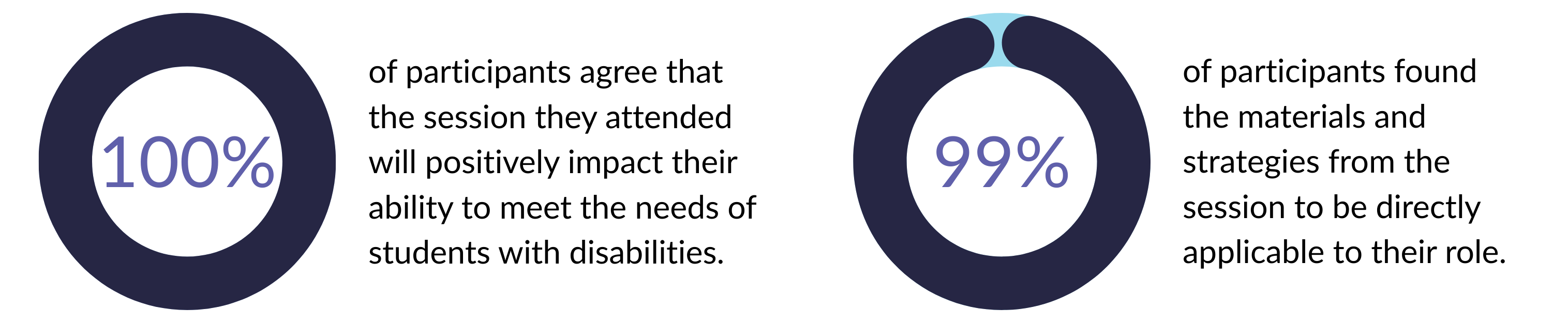
After our first two sessions in February, we are already seeing positive results:
Why This Matters
Students with disabilities deserve, and benefit from, access to grade-level content and quality curriculum materials. That's exactly what this pilot is designed to advance, and because it's CCSSO-funded, we'll share findings with districts nationwide, contributing to the field's understanding of what works. For now, we're grateful to partner with NDE, ESU 8, and NeMTSS Region 3 on this important work.
.svg)
.svg)