Professional Learning Tailored to Your Community: Its Impact
A look at how our team designs and delivers customized professional learning; and the impact across real engagements in Louisiana, Nebraska, and Massachusetts over the past year.
.webp)

Last week, we shared what customized professional learning is and why it matters. This week, we are getting into its impact. Over the past year, our team has designed and delivered over 100 customized professional learning sessions across three states. Each engagement was built around a different partner, a different challenge, and a different school community.
How the Work Gets Built
Every customized engagement starts long before a single participant walks in the room. Depending on the partner and the context, that typically means administering a pre-survey to the intended participants, conducting an audit of existing practices, or working through a series of consultations with district and state leaders to build a clear picture of where educators have strength and where they have room to grow. This data shapes the scope and sequence of what we build, and it ensures that educator voices are centered from the very beginning.
Our approach is responsive and data-informed throughout. In our internal design process, the team works through a set of questions for every session:
- Who is the audience?
- What is the best structure for this group?
- What do we want participants to be able to do at the end?
- How do we want them to apply these skills back in their schools and classrooms?
This level of intentionality before a session is ever delivered is what allows the learning to feel right-timed and right-sized for the community it serves.
During facilitation, our team collects impact data along the way, not just to report on, but to inform meaningful adjustments to session design as the series progresses; ensuring educator voice is present not just in the beginning, but at every moment throughout the engagement. At the close of the series, we measure growth, and that post-data informs follow-up activities to support implementation and sustainability beyond the series itself. The result is professional learning that educators are invested in because they helped build it.
What This Looked Like Across Three States
Louisiana
In Louisiana, we partnered with a large school district to build capacity among educators and paraprofessionals working with students aged three to five. The district had already invested in building a behavior support team and codifying systems to support the transition to school. What they needed next was targeted professional learning to help all educators and paraprofessionals ensure that all students, including those with disabilities, access the existing curriculum every day.
Our team worked closely with early childhood leaders through ongoing consultation meetings to ensure the work stayed on track and aligned to district goals. Across five sessions, participant feedback reflected that the investment in design paid off.
- 97% of participants agreed that the sessions would positively impact their ability to meet the needs of students with disabilities.
- 96% of participants agreed that the strategies covered applied to their role.
- 96% of participants agreed that the facilitator positively impacted their understanding of how to meet the needs of students with disabilities.
- 97% of participants agreed they felt meaningfully included as a participant.
Nebraska
In Nebraska, we partnered with the Nebraska Department of Education (NDE), Education Service Unit 8, and NeMTSS Region 3 to design and deliver a professional learning pilot focused on using high-quality instructional materials to support tiered literacy instruction for students with disabilities. A baseline survey administered identified where educators were starting from, and our team built the training series around what that data revealed. At the conclusion, self-reported readiness scores increased by an average of 37 percentage points across the four areas of lowest baseline readiness. Across every session in the series, 97–100% of participants agreed the learning positively impacted their ability to serve students with disabilities.
You can read the full story of our work with NDE here.
Massachusetts
In Massachusetts, we partnered with the state's Department of Elementary and Secondary Education (DESE) to create and implement a Special Education Administrative Leadership Institute. The institute was intended to develop district leaders’ abilities to implement legal requirements and sound practices for educating students with disabilities. To make the activities within the institute meaningful, we administered a baseline survey and used this to identify the topics that would be responsive to exactly what participants needed; a significant departure from the compliance-based training they were used to.
Like the Louisiana school district, the Massachusetts data told a consistent story across the year.
- 96% of participants agreed that the sessions would positively impact their ability to meet the needs of students with disabilities.
- 100% of participants agreed that the strategies covered applied to their role.
- 98% of participants agreed that the facilitator positively impacted their understanding of how to meet the needs of students with disabilities.
- 100% of participants agreed they felt meaningfully included as a participant.
What Participants Said
In each of these engagements, the content, the audience, and the challenge were unique to each project, while the process behind the work and the outcomes it produced stayed consistent. And as a result, participants felt challenged and included.
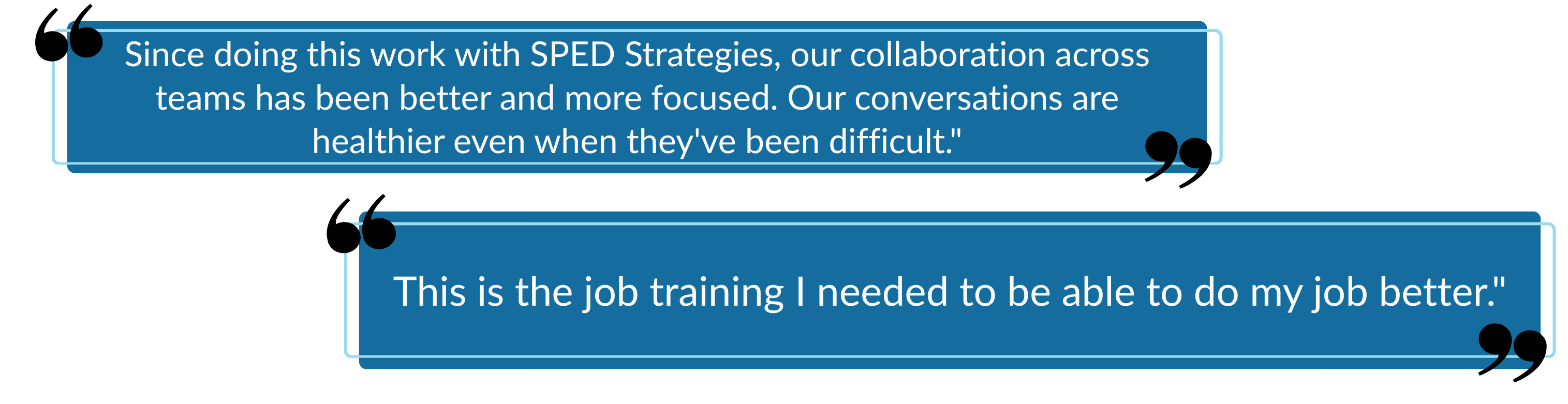
This kind of feedback is the point. When professional learning is built around a community's specific context and challenges, it produces outcomes that carry beyond the series itself.
Ready to See What We Can Build Together?
If your district or state education agency is facing a challenge that deserves a solution built around your context, we would like to hear about it. Click here to schedule time to meet with someone from our team.
.svg)
.svg)