The Results Are In: A Small Dose, A Measurable Shift in Teacher Readiness
The second installment in a two-part series on SPED Strategies' Materials Matter for All pilot with the Nebraska Department of Education, sharing endline survey results from a three-day professional learning series.
.webp)

Last week we shared the story behind our Materials Matter for All pilot with the Nebraska Department of Education: why it was designed the way it was and what the baseline data told us going in. This week, we're sharing what happened on the other side.
The Impact
Following the three-day series, 30 of 31 participants completed an endline survey. The results were striking and near-universal. Across all four low-scoring areas in the baseline survey (Tier 1 and Tier 2–3 HQIM use, IEP-informed lesson design, and general and special education collaboration), self-reported readiness scores increased by an average of 37 percentage points, settling between 73% and 93%. The series moved educators through all three MTSS tiers, from building confidence with Tier 1 embedded supports to applying HQIM in small group instruction and intervention in Tiers 2 and 3.
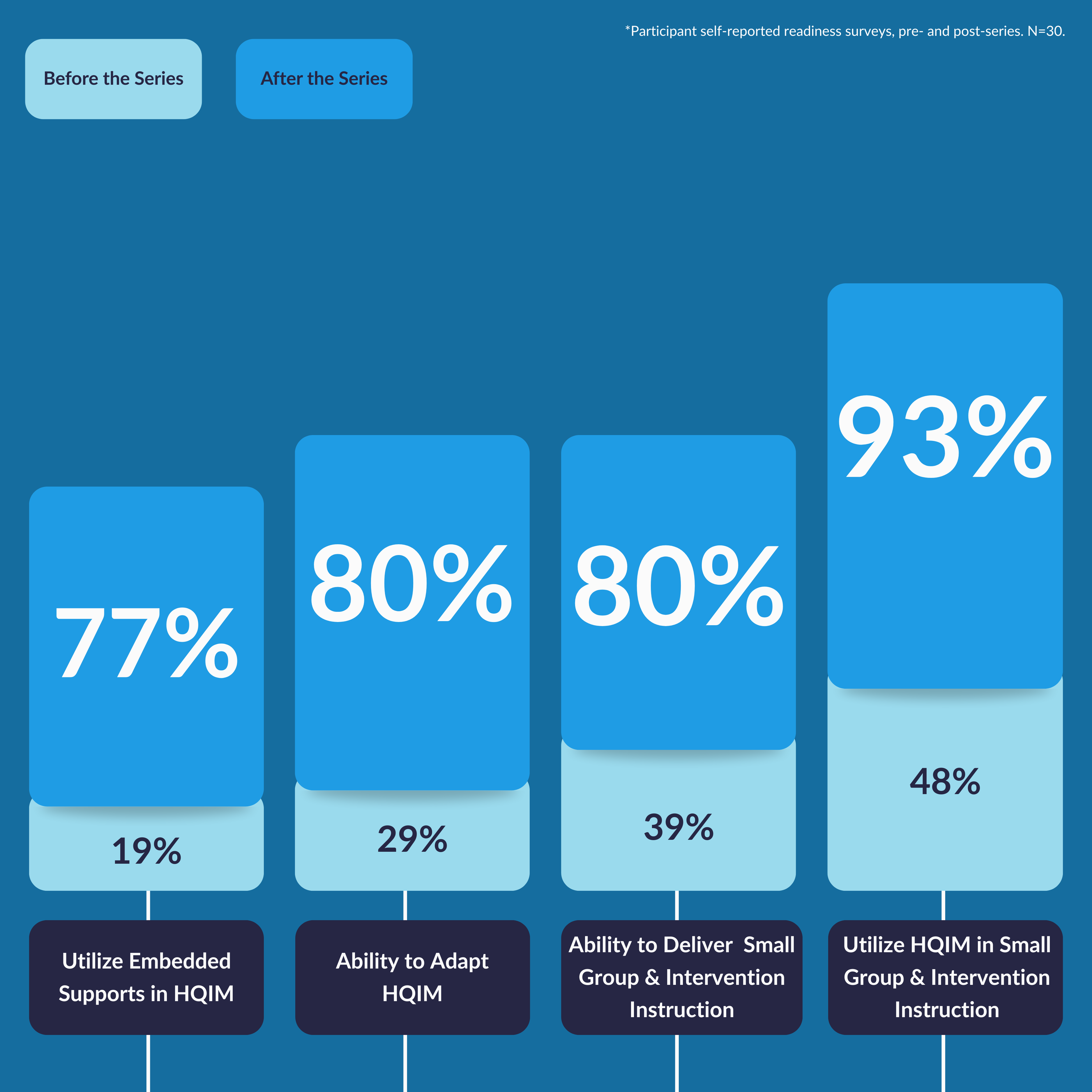
The biggest shifts happened in Tier 1 instruction, the area of greatest need going in. Readiness to use embedded HQIM supports for students with disabilities jumped from 19% to 77%, a 58 percentage point increase. Readiness to adapt HQIM lessons for diverse learners grew from 29% to 80%.
In Tier 2 and 3 intervention, knowledge of how to use HQIM beyond Tier 1 rose from 48% to 93%, and readiness to deliver small group instruction and intervention using HQIM went from 39% to 80%. This happened in a participant group with a 5:1 ratio of general educators to special educators, meaning the gains weren't limited to special education staff.
Across every session in the series, 97–100% of participants agreed the learning positively impacted their ability to serve diverse learners. Several teams facilitated school-wide sessions to share what they'd learned. One school even began restructuring literacy practices that had been in place for over five years.
Unpacking What’s Next
Collaboration between general and special educators saw the smallest growth, and it's worth sharing what we think that tells us. Knowledge of co-planning strategies increased from 65% to 80%, but consistent collaboration only moved from 45% to 50%. Our hypothesis is that unlocking collaboration necessitates more than professional learning — it requires the right structures in place. Things like aligned schedules and dedicated planning time are hard to shift from inside a three-day series targeted at teachers. It's one reason we recommend pairing this kind of work with a leader-facing component that helps administrators build those conditions alongside their teams.
These results reflect self-reported educator readiness, or how prepared participants felt before and after the series. Shifts in perception are a meaningful first step, and the consistency of the results across participants gives us confidence in what this series can do.
What This Means for Your Community
The Materials Matter for All pilot was a proof of concept. The results support what we believed going in: targeted, curriculum-embedded professional learning, delivered to educators who already have their footing with HQIM, produces meaningful, measurable growth in readiness to serve students with disabilities.
This pilot was just the start. We are continuing our partnership with NDE to expand this series across Nebraska, and we will have more to share as that work continues.
If your district is two or more years into HQIM adoption and your data shows students with disabilities falling further behind, that gap is the signal. Let us help you build a solution customized to your community. Click here to schedule time to meet with someone from our team.
The Materials Matter for All pilot was conducted in partnership with the Nebraska Department of Education, ESU 8, and NeMTSS Region 3, funded through a grant for states in the Instructional Materials and Professional Development (IMPD) Network through the Council of Chief State School Officers (CCSSO).
.svg)
.svg)